 Carnahan, John Andrew (1926 - 2017)
Born on 9 Oct 1926 where?; died on 2 June 2017 (aged 90) in Canberra, ACT.
He was an ecologist and foundation member of the
Ecological Society of Australia (ESA).
He was appointed Senior Lecturer in Botany (Plant Ecology) at the Australian National University (ANU) in 1963. He remained at ANU till the early 1990s.
He was a prominent figure in the field of vegetation mapping and classification, known for his work in producing the "Natural vegetation" map for the Atlas of Australian Resources, Second Series in 1977.
In his own words (2010):
I have spent most of my academic and other working life (since 1972) investigating biodiversity, balancing the needs of biodiversity with those of production, and bridging the cultures of those who think Darling Harbour is a long way west with those who live on the other side of the sandstone curtain.
The culture of many biodiversity officers in government departments is often very different from the culture of many primary producers, especially landholders in the western areas of NSW. These incompatibilities lead to culture "wars", which are undesirable and counter-productive to both biodiversity and production agriculture, and very counter-productive to sustainable agriculture and land management. I have had a few successes along the way (and some failures).
I have worked on waterbirds, wetlands, woodland condition and birds, cropping and grazing management, soil and eco-hydrology, wildlife management, and incentive schemes and policy instruments for biodiversity conservation and management. I have published a respectable number of papers, and have haunted the mini-corridors of power in my department - NSW Dept. Environment, Climate Change and Water (and very occasionally in Minister's offices). I have driven policy officers mad with my advice (which they usually ignore, but occasionally find useful). I remain concerned that some ecologists cling to long-outmoded, disciplinary silos of zoology and botany, and that some of us do not realise that conservation biology is as much about people as it is about ecology. Cultural understanding of people is as important for conservation management as are skills in ecology.
I am about to move to the University of Canberra, as an Adjunct Professor in the Institute of Applied Science.
I aim to help expand the horizons of post-graduate students, help them understand policy worlds, finish a few papers (most of my work is written up, but a little bit is not), and explore institutional frameworks and cultures and the impediments and opportunities that these provide for natural resources management, in discussion and writing.
(These reflections were offered to the Ecological Society of Australia (ESA) on the occasion of its 50th anniversary in 2010.)
Source: Extracted from:
https://www.ecolsoc.org.au/blog/a-walk-down-memory-lane-reflections-from-esas-50th-anniversary/
Purdie, RW (ed.) (2019) 'The last 50 years informing the next
50: Proceedings of the Black Mountain Symposium, 24-25 August 2018', p.331, Friends of Black Mountain, Canberra.
https://www.findagrave.com/memorial/202674729/john-andrew-carnahan
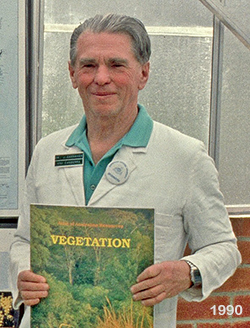
Portrait Photo: 1990, Mike Crisp, ANBG Photo Collection H-396.
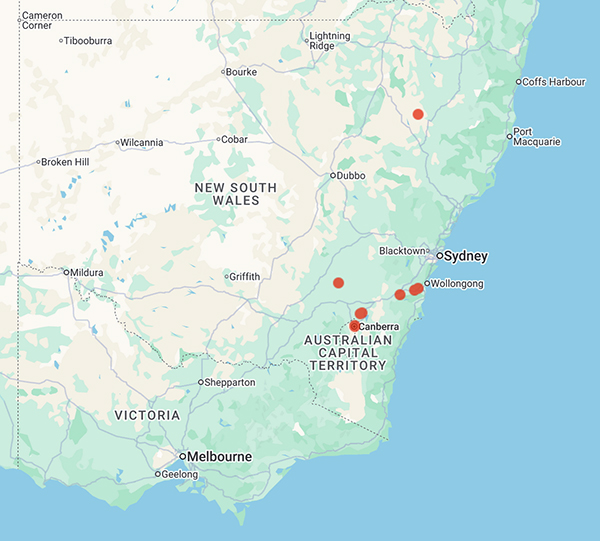
Collecting localities for 'Carnahan, J.' from AVH (2025)
Data from 17 specimens