 Young, James Edgar (1871 - 1956)
Born on 1 December 1871 in Brisbane; died on 28 June 1956 in Brisbane, aged 84.
He was educated at Ipswich Grammar School, and later training as an architect in Sydney.
After returning to Queensland, he lived in Beenleigh, where he practiced as an architect before trying his hand at farming, owning property near Toowoomba.
In 1911, he moved with his family to Graceville, residing at 'Molonga' and worked again briefly as an architect.
Young's interest in the outdoors led him to join the Field Naturalists Club in 1914 and for the following decade his work was in the area of natural history.
In 1923, Young was selected to be part of the British Museum funded expedition of Hubert Wilkins to collect fauna and flora for the museum collection which took him as far as Cape Grenville
and nearby Temple Bay in northern Cape York.
This quote from Jim Rogers' Wilkins' biography suggest many J.E. Young specimens might be in the British Museum:
"At the end of this [Wilkins] expedition he had spent nearly two and a half years in the bush (1923-1925) travelling with scientists J.E. Young, Vladimir Kotoff and Oscar G. Cornwell. Between them they had collected hundreds of specimens and many boxes of fossils and minerals."
Following this expedition, Young became an honorary collector for the Queensland Museum, travelling around Queensland collecting flora and fauna.
As enthusiastic as he was as a collector of fauna and
fossils for the Queensland Museum, Edgar Young was
also a keen botanist and plant collector and collected over the period
stretching from 1914 to 1938, and from all over
Queensland.
In 1928-1929 he was part of the Cambridge University Low Isles expedition, led by Dr C.M. Yonge and in 1929, he undertook a collecting trip to Papua accompanying C.L. Fox , an ex-inspector of Queensland schools undertaking an inspection of mission schools.
Young retired in 1932, but between 1938-1940, participated in three expeditions to the Carnarvon Ranges.
In 1935, near Hughenden, he made the significant discovery of the most complete specimen of a Cretaceous ichthyosaur (Platypterygius australis).
The John Oxley Library, State Library of Queensland holds a collection of lantern slide and glass plate negative known as the James Edgar Young collection. This collection contains approximately 350 lantern slides and 18 glass plate negatives relating to the life of J. Edgar Young, Queensland field naturalist. Most of the photographs are assumed to have been taken by Young. The lantern slides include approximately 78 images from Young's 1929 trip to New Guinea; numerous images from the 1923 Wilkins Expedition including some that were used in Wilkins book 'Undiscovered Australia'; images from various other Queensland trips Young participated in including Low Isles, Hughenden, Ballandean, and Stradbroke Island; images of specimens of flora and fauna from Young's trips.
Xanthostemon youngii C.T.White & W.D.Francis (1926), is named after James Edgar Young,
who first observed it.
Source: Extracted from:
https://trove.nla.gov.au/work/255439641?keyword=Young,%20James%20Edgar
https://www.findagrave.com/memorial/191854477/james-edgar-young
Alan Rix (2025) "Jess Young” and “J. E. Young”: 19th and 20th
century expedition collectors,
ASBS Newsletter No.203, Dec. 2025.
Jim Rogers: https://www.saam.org.au/history_group_docs/SAAM%20Biography%20-%20WILKINS%20Sir%20George%20Herbert%20.pdf
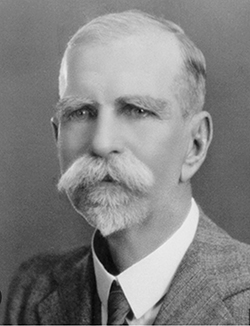
Portrait Photo: https://sherwoodarboretum.com.au/discover/discover-our-heritage-trail
Image courtesy of the Oxley - Chelmer History Group Inc.
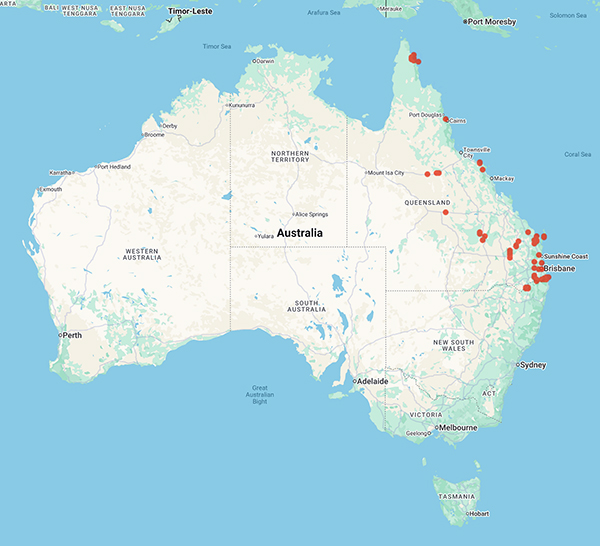
Collecting localities for 'Young, J.E.' from AVH (2025)
Data from 418 specimens